
PedroVazPaulo Business Consultant: How Long Do Consulting Engagements Last?
Growing a company creates problems that are different from starting one. Leaders must choose markets, improve systems, manage cash, and build teams without slowing momentum. PedroVazPaulo Business Consultant positions its services around those challenges, with a particular focus on startups and small and medium-sized enterprises seeking structured growth. The goal is not simply to deliver a report, but to turn strategic priorities into practical actions that managers can execute.
This guide explains the firm’s stated services, consulting process, market-expansion focus, and typical engagement lengths. It also shows business owners how to evaluate the consultancy before signing a contract. That step matters because consulting value depends on verifiable expertise, a clear scope, measurable outcomes, and transparent fees. A strong fit can accelerate decision-making, while a weak fit can consume time and budget without producing durable improvement.
What Is PedroVazPaulo Business Consultant?
PedroVazPaulo Business Consultant presents itself as a boutique advisory firm serving growth-oriented SMEs and startups. Its public positioning emphasizes strategic planning, operational efficiency, leadership alignment, and expansion into Southeast Asian markets. Unlike a large consulting company that may assign several specialists, a boutique model usually offers closer access to the lead consultant and a more customized working relationship. That structure can benefit founders who need direct guidance rather than a standardized framework.
The firm says it uses a hands-on, outcome-focused approach built around tailored roadmaps and measurable key performance indicators. In practical terms, that should mean identifying the business problem, agreeing on specific targets, implementing changes, and reviewing results regularly. Companies should still ask for evidence before hiring, including relevant case studies, references, consultant credentials, and examples of deliverables produced for businesses facing comparable challenges.
What Services Does the Firm Provide?

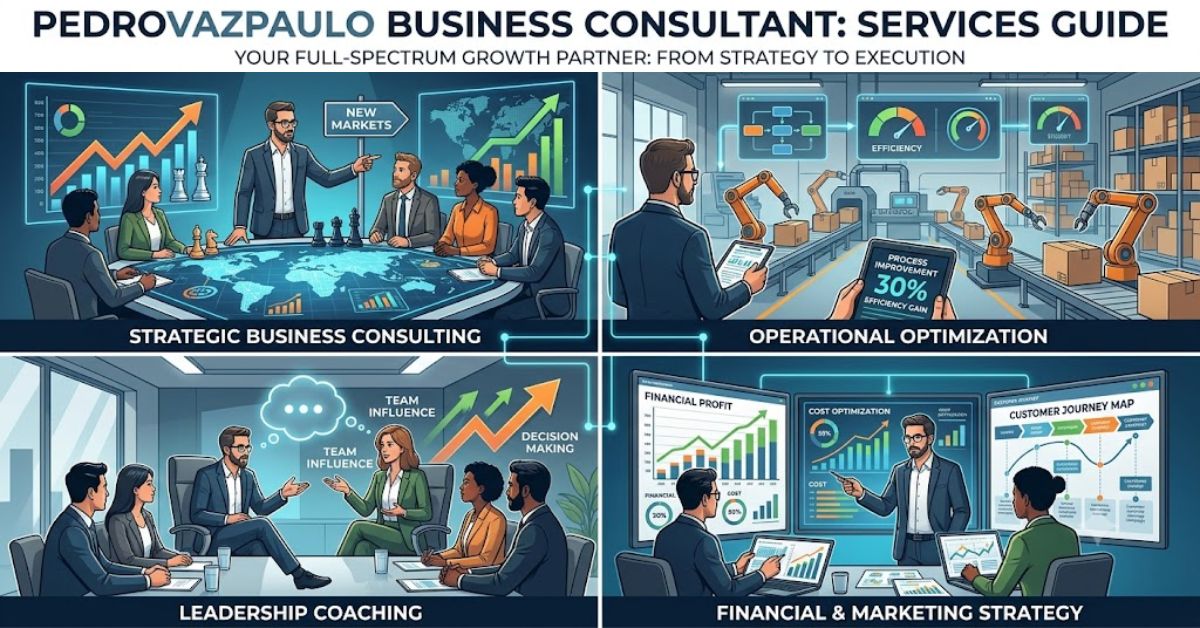
The service mix covers several connected areas of business growth. Strategic planning establishes priorities and long-term direction. Market expansion addresses research, localization, partnerships, pricing, and entry risks. Operational efficiency focuses on workflow bottlenecks, waste reduction, digital tools, and productivity. Leadership development helps executives improve decision-making and accountability. Financial advisory may cover business risk, restructuring, budgeting, and investment analysis, depending on the consultant’s qualifications and the agreed scope.
These services should not operate as isolated projects. A market-entry plan can fail when operations cannot handle new demand. Digital transformation can waste money when leadership has not defined the problem it should solve. Financial restructuring can create only temporary relief when weak processes remain unchanged. PedroVazPaulo Business Consultant is therefore most relevant when a company needs an integrated growth strategy that connects market opportunity, internal capacity, leadership behavior, and financial discipline.
| Service | Main purpose | Useful business outputs |
|---|---|---|
| Strategic planning | Set priorities and direction | Growth roadmap, competitive analysis, KPI plan |
| Market expansion | Enter a new country or region | Market-entry plan, localization strategy, partner criteria |
| Operational efficiency | Improve speed, cost, and quality | Process map, bottleneck analysis, automation roadmap |
| Financial advisory | Strengthen business decisions | Risk review, scenario model, restructuring priorities |
| Leadership development | Improve management execution | Coaching plan, accountability system, decision framework |
How Does the Consulting Process Work?
A useful consulting engagement starts with diagnosis, not a prewritten solution. The consultant must understand the company’s goals, customer base, financial constraints, workflow, leadership structure, and competitive environment. The firm describes a three-phase approach centered on clarification, execution, and sustainable scaling. That sequence is sensible because it prevents teams from buying technology, entering markets, or restructuring departments before they have defined the underlying problem and the desired business result.
PedroVazPaulo Business Consultant should also establish governance early. The contract needs a project owner, decision rights, meeting schedule, deliverables, deadlines, and success metrics. Without those controls, consulting projects often become open-ended discussions. The client should know what will be delivered each month, who must provide data, which decisions require executive approval, and how progress will be measured against the original baseline.
A practical engagement can follow these steps:
- Define the business problem and desired outcome.
- Review market, financial, operational, and leadership data.
- Prioritize the highest-impact opportunities.
- Build an implementation roadmap with owners and deadlines.
- Test changes through focused pilots.
- Track KPIs and adjust the plan.
- Transfer systems and knowledge to the internal team.
Who Is the Best Fit for These Services?
The firm’s stated focus makes it most relevant to startups and SMEs that have reached a growth constraint. A technology company may need a digital transformation roadmap before expanding. A manufacturer may need supply chain optimization and better production workflows. A retailer may require localization, channel analysis, and consumer research before entering Southeast Asia. A service business may need standardized processes so growth does not reduce quality or customer satisfaction.
The best clients are usually willing to share reliable data, assign internal owners, and make difficult decisions. Consulting cannot fix a company whose leaders refuse accountability or expect an outsider to execute everything. Businesses exploring Southeast Asia should also demand country-specific evidence because the region is not one uniform market. Regulations, languages, purchasing behavior, distribution systems, and partnership norms differ significantly between countries.
Use this readiness checklist before engaging a consultant:
- The growth problem is clearly defined.
- Leadership agrees on the desired outcome.
- Relevant financial and operational data is available.
- An internal project owner has authority.
- The company can commit time to implementation.
- Market-entry assumptions can be tested before major investment.
- Success can be measured with specific KPIs.
How Long Do Consulting Engagements Last?

Project length should match complexity rather than an arbitrary package. The firm states that market-entry and regional-expansion work may run for three to six months. Operational optimization and scale-up projects may require six to twelve months. Leadership alignment and sustainable-growth programs can continue for more than twelve months. These ranges are reasonable as planning estimates, but the contract should connect duration to milestones instead of paying for time without defined progress.
A short engagement works when the problem is narrow and decision-ready. A longer engagement becomes necessary when the company must redesign processes, train teams, install digital tools, or coordinate several departments. PedroVazPaulo Business Consultant should be expected to explain why each phase requires its proposed timeline. Clients should also negotiate review points that allow them to continue, revise, or end the engagement based on results.
| Engagement type | Typical stated length | Main focus |
| Market entry and regional expansion | 3–6 months | Research, positioning, localization, launch planning |
| Operational optimization and scale-up | 6–12 months | Processes, productivity, digital tools, execution |
| Leadership alignment and sustainable growth | 12+ months | Management systems, coaching, culture, long-term capability |
How Should You Evaluate and Book a Consultation?
Start by treating the first strategy call as a qualification meeting, not a sales presentation. Ask the consultant to explain experience with your industry, company size, and target market. Request a sample project plan, reporting format, references, and a clear fee structure. The public website provides booking options for market expansion, operational efficiency, and leadership-related services, but a booking page alone does not prove expertise or guarantee results.
Financial services require extra caution. Business budgeting, cash-flow analysis, and operational risk planning are different from regulated investment advice. U.S. companies seeking securities or investment recommendations should verify the professional’s registration and background through appropriate regulatory databases. For every project, confirm confidentiality terms, data security, intellectual-property ownership, termination rights, and who will perform the work before sharing sensitive company information.
| Factor | Boutique consultant | Large consulting firm | Freelance specialist |
| Senior-level access | Often direct | Can be limited | Usually direct |
| Breadth of expertise | Moderate | Broad | Narrow to moderate |
| Customization | Usually high | Varies | Usually high |
| Resources for large projects | Limited to moderate | High | Limited |
| Cost structure | Often mid-range | Usually highest | Often lowest |
| Best use | Focused growth and execution | Complex enterprise transformation | Specific technical problem |
Questions to ask during the strategy call:
- What similar projects have you completed?
- Which results can be independently verified?
- Who will work on the engagement?
- What will be delivered in the first 30 days?
- Which KPIs will define success?
- What information must our team provide?
- What risks could prevent the project from succeeding?
- What happens if milestones are missed?
Conclusion
PedroVazPaulo Business Consultant may suit startups and SMEs seeking support with strategic planning, operational efficiency, market expansion, financial decision-making, or leadership development. Its boutique and hands-on positioning can be attractive to companies that want direct access and customized guidance. The real value, however, will depend on the consultant’s verified experience, the quality of the diagnosis, and the discipline used to turn recommendations into measurable action.
Before committing, compare the proposed scope with your actual business problem, verify credentials and case studies, and insist on clear deliverables, KPIs, responsibilities, and review points. No consultant can replace capable leadership or guarantee growth. A strong engagement gives leaders better analysis, stronger systems, and a practical route forward while leaving the organization more capable after the project officially ends.