

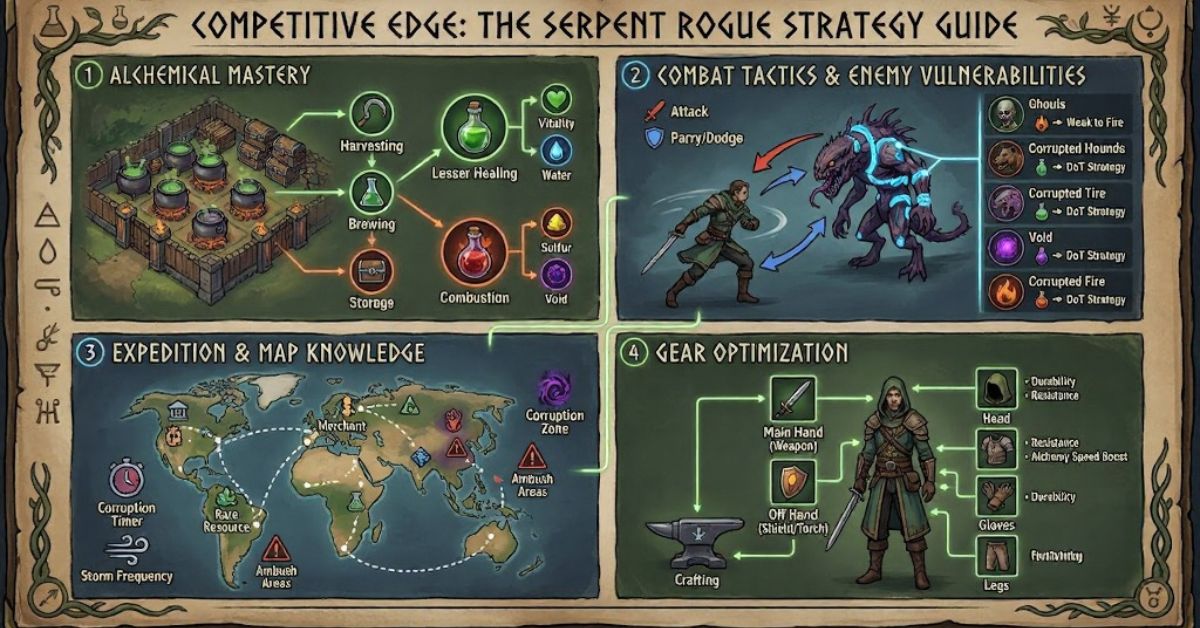
Players searching for Competitive Edge Theserpentrogue guidance are usually not looking for a stronger sword. They need a smarter way to survive. The Serpent Rogue rewards preparation, experimentation, and environmental awareness more than reckless aggression. Alchemy, creature management, shapeshifting, and map knowledge work together as one survival system. Once you understand those connections, difficult areas become manageable and costly mistakes become much easier to avoid.
The game officially centers on mastering alchemy, taming wild creatures, exploring a changing world, and dealing with consequences created by your actions. Unburied bodies attract ghouls, crowded creature populations attract reapers, and stockpiled items can invite vermin. That design makes knowledge your most dependable advantage. The goal of this guide is to turn those systems into a practical routine you can repeat during every expedition.
Master Alchemy Before Entering Dangerous Areas
The deep alchemy system is the foundation of efficient progression. Instead of treating ingredients as random loot, research each material and record what it does. Common resources may require more samples to identify, while rarer materials can reveal their properties with fewer units. Experimentation costs resources, but blind combat costs weapons, health, and time. Ingredient discovery therefore pays for itself by opening safer solutions to future problems.
Use a controlled brewing process rather than combining everything at random. First, identify a problem such as poison, hunger, healing, damage, or transformation. Second, choose ingredients with effects that match that problem. Third, test small batches and keep successful formulas available near your base. This approach helps uncover hidden potion recipes while reducing waste. It also turns your storage into a working laboratory instead of a pile of unexplained materials.
Follow this basic experimentation process:
- Research one ingredient group at a time.
- Decide which effect you are trying to produce.
- Brew the smallest practical test batch.
- Record successful combinations.
- Restock ingredients used in essential potions.
- Keep emergency brews separate from experimental ones.
Useful potion categories include:
- Healing and recovery
- Direct damage
- Poison and burning effects
- Hunger or behavioral disruption
- Creature transformation
- Summoning or creature creation
- Exploration and utility effects
Use Potions and Protect Weapon Durability
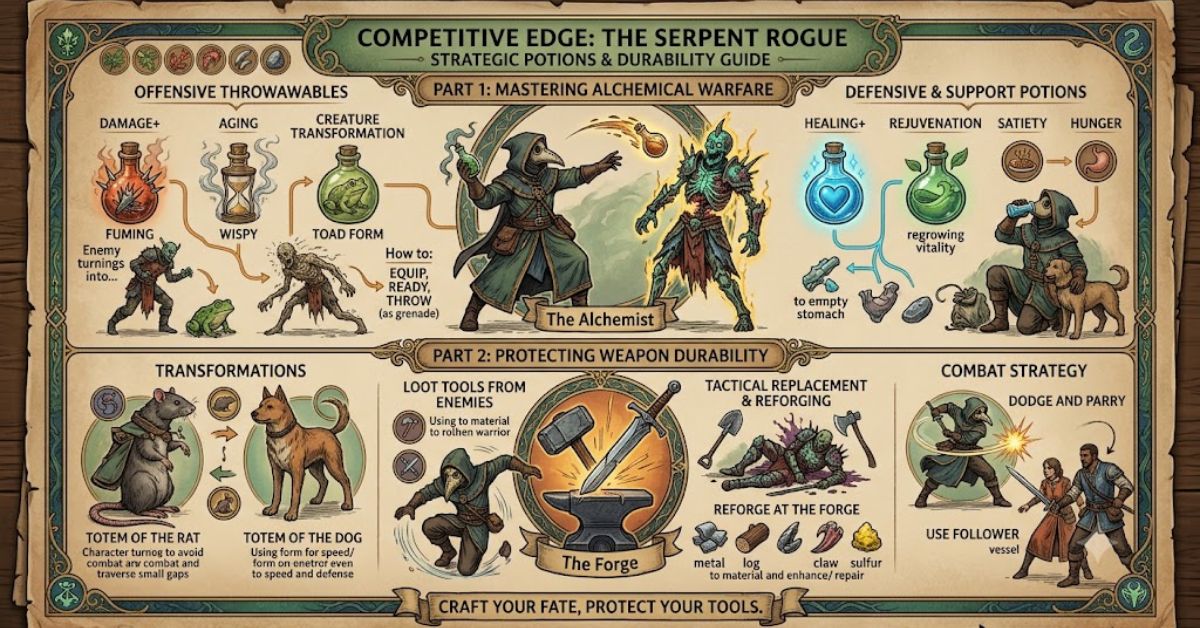
A practical Competitive Edge Theserpentrogue strategy treats physical weapons as limited tools, not permanent answers. Every weapon and tool has durability, and broken equipment leaves you fighting with your fists. Although durability was increased after launch, careless melee still consumes valuable gear. Use direct combat when the target is isolated, predictable, and worth the cost. Against groups or dangerous enemies, brewed potions and tactical status effects usually offer better control.
Potions can weaken enemies, apply damage over time, disrupt behavior, or create an opening to escape. That makes them weapon alternatives rather than optional extras. You should also compare the expected reward with the durability, healing supplies, and inventory space at risk. Running away is not failure when the fight has poor economics. It is risk mitigation. Preserving your inventory often creates more progress than winning one unnecessary skirmish.
| Combat approach | Main advantage | Primary risk | Best situation |
|---|---|---|---|
| Physical weapons | Fast, direct damage | Durability loss and close-range damage | Isolated, manageable enemies |
| Damage potions | Preserves weapon durability | Consumes ingredients | Groups or dangerous targets |
| Status effects | Weakens or controls enemies | Requires preparation | Longer or tactical encounters |
| Tamed creatures | Divides enemy attention | Followers can be lost | Controlled group fights |
| Retreating | Protects gear and inventory | No immediate reward | Unfavorable or unnecessary fights |
Before starting a fight, ask:
- Does this enemy block my objective?
- Is the expected reward worth the equipment cost?
- Do I have an escape route?
- Can a potion solve the problem more safely?
- Will fighting attract additional enemies?
Manage the Cause-and-Effect World Economy
The cause-and-effect economy punishes sloppy housekeeping. Corpse management matters because unburied bodies attract aggressive ghouls that attack whatever they encounter. Population control matters because too many creatures in one place can draw bloodthirsty reapers. Item hoarding also creates problems by attracting plague-spreading vermin. These threats are not random punishment. They are predictable responses to the way you organize your base and surrounding areas.
Build cleanup into every return trip. Bury defeated entities before leaving an area, spread tames across safe locations, and avoid dropping large piles of materials in one spot. Keep only frequently used ingredients near your brewing station. Move overflow into separate storage areas when possible. This simple routine lowers the chance that a successful expedition creates a new emergency at home. Good survival play includes what happens after combat, not only during it.
| Player behavior | World consequence | Preventive response |
| Leaving bodies unburied | Corpse-eating ghouls appear | Bury defeated entities promptly |
| Keeping too many creatures together | Reapers are attracted | Limit and separate your tames |
| Hoarding items in one location | Vermin infest the area | Divide and organize stored resources |
| Ignoring environmental buildup | Several threats can overlap | Perform cleanup after every expedition |
A basic base-management checklist should include:
- Bury nearby corpses.
- Count active tames and followers.
- Separate unnecessary creatures.
- Sort ingredients by purpose.
- Remove excess items from the ground.
- Keep emergency supplies accessible.
- Inspect the area before leaving again.
Use Shape-Shifting and Taming Strategically
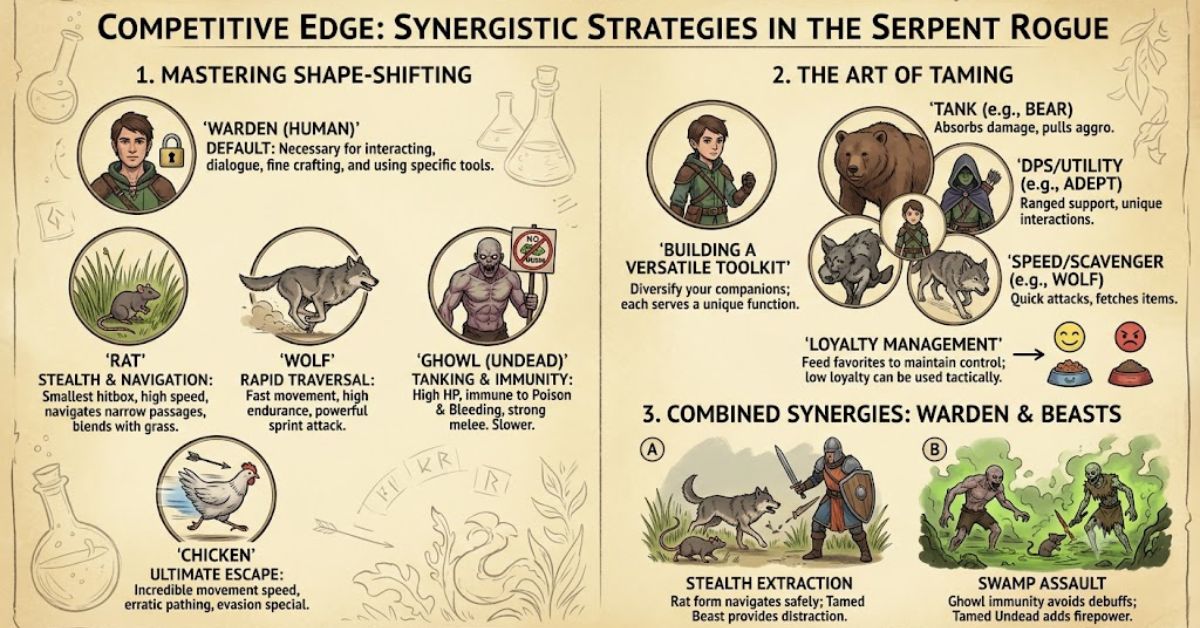
Shape-shifting expands your options beyond combat. Specialized potions let the Warden take creature forms that provide different movement, access, or fighting capabilities. Some forms can reach areas that are difficult or impossible to enter normally. However, transformed characters cannot use weapons or regular items, so form swapping requires planning. Enter a new form with a clear purpose, a safe exit route, and enough time to complete the task.
Beast taming provides another layer of flexibility. Tamed creatures can support fights, absorb pressure, or help protect important areas, but they are not free power. Too many followers concentrated together can trigger reaper activity. Use a small, purposeful roster instead of collecting every creature you find. A balanced group should cover a specific weakness, such as frontline protection, distraction, or extra damage, without turning your base into an overpopulation hazard.
Before transforming, confirm:
- The form provides a useful ability.
- You know where you are going.
- You will not need immediate access to an item.
- The destination has a safe place to change back.
- Your normal equipment will not be required during the route.
Before taming another creature, ask whether it adds a function your existing followers cannot provide. Collecting creatures without a purpose increases management work and environmental risk without necessarily improving your survival chances.
Explore With a Resource Plan
Strategic exploration is about resource optimization, not covering every inch of the map on every run. Learn where valuable ingredients, crafting materials, and random loot commonly appear. Official descriptions emphasize searching the changing world for rare ingredients and secret areas, while guides show that specific materials often come from particular creatures, containers, or regions. Route knowledge reduces wasted movement and limits exposure in high-threat zones such as the Wasteland.
Before entering a dangerous region, define one objective. You might need Mandragore, scrap metal, a creature component, or a quest item. Carry only the tools required for that objective and leave unnecessary valuables behind. Mark reliable spawn areas mentally or in your own notes. If conditions turn unfavorable, retreat and return later. Knowledge of the map becomes your greatest asset because it shortens each run and protects the resources already earned.
Use this objective-based exploration method:
- Select one required material or quest item.
- Identify its most reliable source.
- Choose the shortest safe route.
- Empty unnecessary inventory slots.
- Carry healing, escape, and transformation supplies.
- Avoid enemies unrelated to the objective.
- Return once the target resource has been collected.
This Competitive Edge Theserpentrogue approach prevents exploration from becoming uncontrolled wandering. It also makes failure less expensive because you carry fewer valuable items into dangerous regions.
Conclusion
The Serpent Rogue becomes easier when you stop treating it like a conventional action game. Master the alchemy system, use status effects before fragile weapons, manage corpses and creature populations, and treat shapeshifting as a planned utility. Taming can strengthen your position, but uncontrolled collecting creates new threats. Each system rewards restraint, preparation, and an understanding of consequences rather than constant fighting.
Ultimately, Competitive Edge Theserpentrogue success comes from making fewer expensive mistakes. Research ingredients, plan resource routes, retreat from poor fights, and clean up after every expedition. Those habits preserve equipment, protect your inventory, and keep the world from reacting against you. When knowledge guides every decision, survival becomes more predictable and progression becomes faster without relying on brute force.