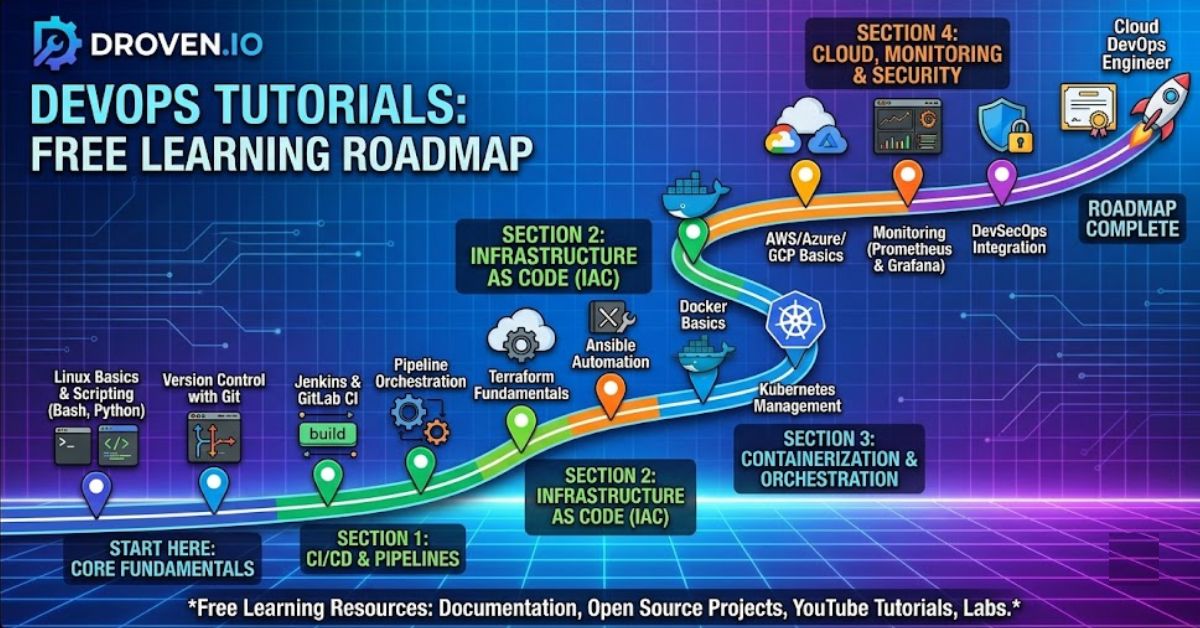
Droven io Devops Tutorials: Free Learning Roadmap
Searches for Droven io Devops Tutorials usually come from learners who want one clear place to study automation, cloud deployment, and modern software delivery. Droven.io exists, but its current structure is broader than a dedicated DevOps academy. It publishes technology, cloud, cybersecurity, and software-development content rather than a complete beginner-to-advanced curriculum. Treat it as a supporting resource, not your only learning path.
You can build the same practical skills through free, well-organized alternatives. A strong plan combines a visual DevOps roadmap, official documentation, guided modules, free DevOps courses, videos, and hands-on projects. The goal is not to finish every course. It is to understand the delivery lifecycle, practice each tool, and prove your knowledge by building a working CI/CD pipeline from code commit through deployment and monitoring.
Is Droven io a Dedicated DevOps Tutorial Platform?
At the time of review, Droven.io presents itself as a technology and enterprise-content website covering information technology, software development, cloud computing, cybersecurity, and related subjects. Its information-technology section mentions DevOps, but the site does not appear to offer a sequenced course with labs, assessments, prerequisites, and portfolio projects. That distinction matters because scattered articles rarely provide the progression beginners need.
The best interpretation of Droven io Devops Tutorials is a search for Droven-related material plus dependable alternatives. Use individual Droven.io articles when they answer a focused question, such as cloud optimization or software-delivery practices. For systematic training, pair those articles with a structured roadmap and primary documentation. This prevents knowledge gaps and creates a measurable path from basic Linux commands to production-ready automation.
The Zero-to-Hero DevOps Roadmap
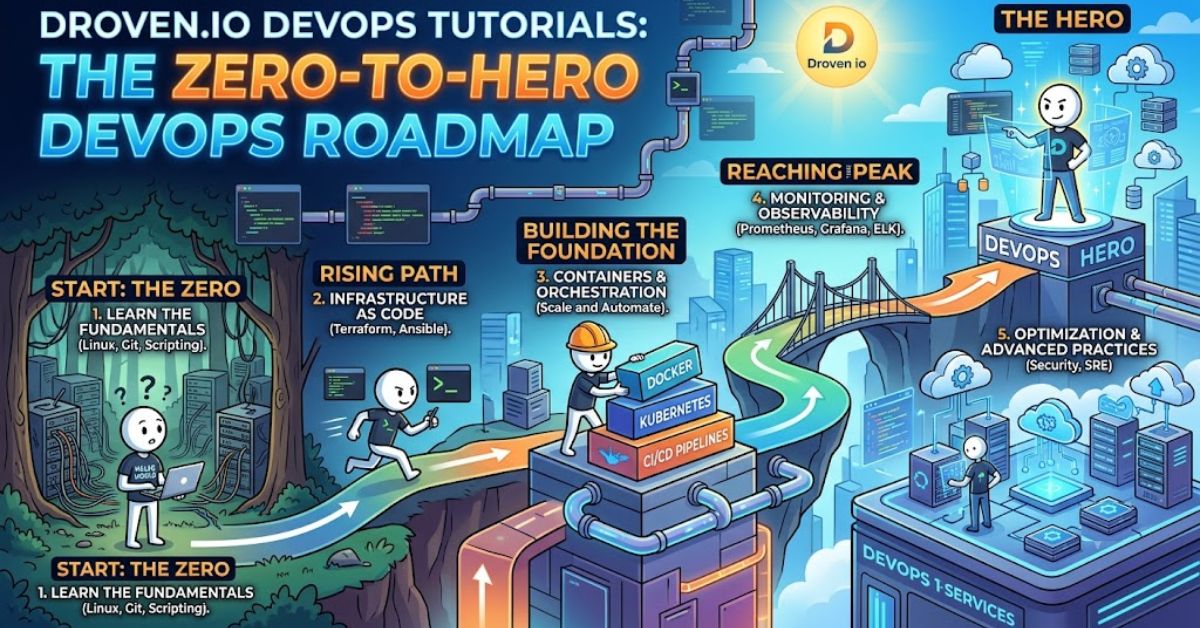
DevOps is not a single application. It improves software delivery through collaboration, automation, feedback, and shared responsibility. A practical DevOps roadmap begins with Linux, networking, scripting, and Git. It then moves into continuous integration, testing, containers, infrastructure as code, cloud platforms, orchestration, security, and observability. Roadmap.sh organizes these areas into a visual learning path for beginners and experienced engineers alike.
Follow the sequence instead of starting with Kubernetes because it looks impressive. Kubernetes becomes easier after you understand processes, ports, files, images, registries, and Docker networking. A CI/CD pipeline also makes more sense after you can create branches, commit code, open pull requests, and resolve conflicts. The Droven io Devops Tutorials path should move from operating-system fundamentals toward automation, deployment, and monitoring.
| Learning phase | Core skills | Suggested tools | Proof of learning |
|---|---|---|---|
| Foundations | Linux, networking, Bash, Git | Ubuntu, Git, GitHub | Manage a repository and automate a shell task |
| Build and test | Dependencies, unit tests, CI | Maven or Gradle, GitHub Actions or Jenkins | Run tests automatically on every push |
| Package and deploy | Containers and registries | Docker, Docker Compose | Build and publish a reusable image |
| Orchestrate | Scaling, services, configuration | Kubernetes | Deploy and update a multi-service app |
| Automate infrastructure | Configuration and provisioning | Ansible, Terraform | Recreate an environment from code |
| Observe systems | Metrics, dashboards, alerts | Prometheus, Grafana | Detect and investigate a simulated failure |
Use this readiness checklist before advanced orchestration:
- Work comfortably in a Linux terminal.
- Understand Git branches, commits, merges, and pull requests.
- Explain processes, ports, DNS records, and environment variables.
- Build and run a Docker image without copying commands blindly.
- Read YAML and troubleshoot a failed automation job.
Best Free Alternatives for DevOps Learning
Roadmap.sh is useful for sequencing, while Microsoft Learn provides guided DevOps career training and an introductory module on principles and practices. GeeksforGeeks and TutorialsPoint offer searchable beginner lessons, making either a useful DevOps tutorial for beginners. Once you begin using a tool, official documentation should become your main reference. GitHub, Docker, Kubernetes, Ansible, Prometheus, and Grafana all maintain getting-started resources.
Do not select a platform only because its course is long. A five-hour video can provide orientation, but passive viewing does not create operational skill. Pause after each section, reproduce the demonstration, change one variable, and document what broke. When comparing Droven io Devops Tutorials alternatives, favor current commands, sample repositories, exercises, troubleshooting guidance, and projects that connect several tools.
| Resource | Best use | Main strength | Limitation |
| Roadmap.sh | Planning the learning order | Clear visual sequence and project ideas | Needs outside resources for deep instruction |
| Microsoft Learn | Cloud and Azure DevOps fundamentals | Guided modules from Microsoft | Emphasizes the Microsoft ecosystem |
| GeeksforGeeks | Quick explanations and revision | Broad beginner coverage | Depth varies by topic |
| TutorialsPoint | Basic concepts and terminology | Simple, linear reading | Less project-focused |
| Official documentation | Accurate tool usage | Primary-source commands and current features | Can feel dense for beginners |
Build a Portfolio-Ready DevOps Project
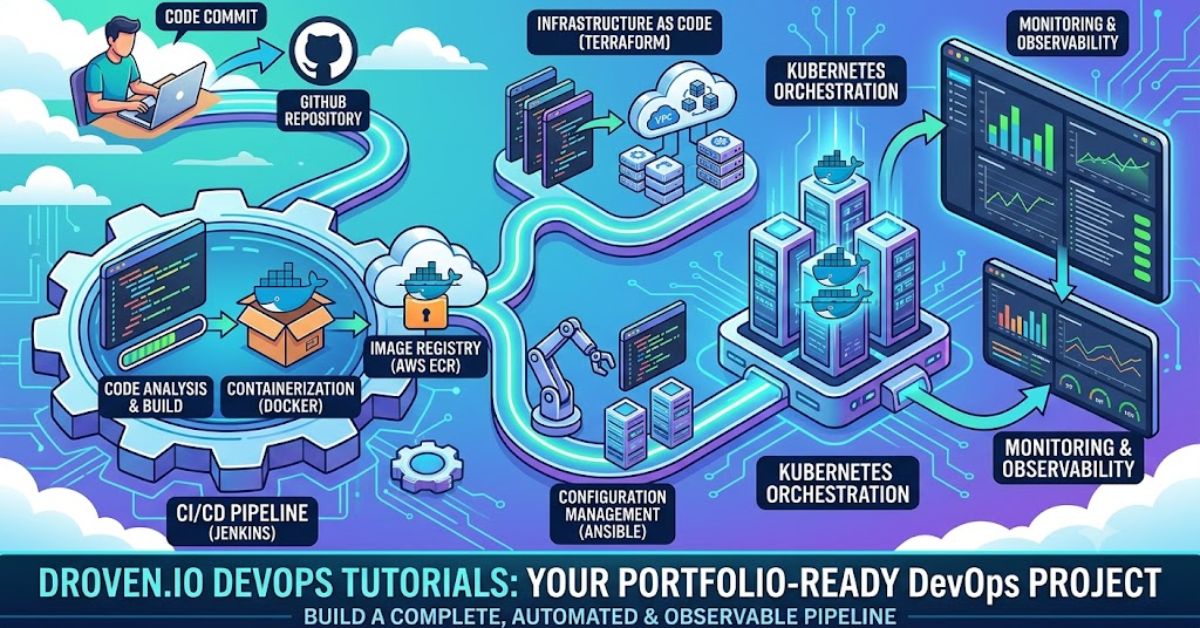
Your capstone should demonstrate a complete delivery loop rather than a collection of screenshots. Start with a small web application in GitHub. Add automated tests, build a Docker image, publish it to a registry, deploy it to Kubernetes, configure the environment through code, and collect metrics. Docker and Kubernetes provide official guides for these foundational workflows and deployment concepts.
Then simulate a real incident. Break a health check, increase application errors, or stop a service. Use Prometheus metrics and a Grafana dashboard to identify the problem, restore service, and write an incident report. This turns a technical demo into evidence of operational thinking. It shows that you can deploy software, observe behavior, troubleshoot failures, and improve the system rather than follow only a happy-path tutorial.
Build the project in this order:
- Create a GitHub repository and branching workflow.
- Add unit tests and a CI workflow.
- Build a Docker image and run it locally.
- Push the image to a container registry.
- Deploy the application to a local Kubernetes cluster.
- Automate configuration with Ansible or infrastructure code.
- Add Prometheus metrics, Grafana dashboards, and an alert.
- Document the architecture, failures, and lessons learned.
Project publication checklist:
- The README includes architecture and setup steps.
- Secrets are never committed.
- CI fails when tests fail.
- Deployment works from a clean environment.
- Monitoring shows application and infrastructure health.
- The repository includes a troubleshooting example.
- Screenshots support the explanation but do not replace working code.
Conclusion
The most useful answer to Droven io Devops Tutorials is not one course link. Droven.io can support topic discovery, but complete DevOps training needs a structured roadmap, primary documentation, deliberate practice, and an integrated project. Begin with Linux and Git, progress through CI/CD and Docker, then carefully add Kubernetes, infrastructure automation, cloud services, security, and observability in a logical order.
Use free platforms strategically instead of jumping between random tutorials. Plan with Roadmap.sh, study guided concepts through Microsoft Learn or beginner sites, and verify commands in official documentation. Most importantly, build, break, monitor, and repair a real project. That process transforms Droven io Devops Tutorials from a search phrase into a practical system that can prepare you for junior DevOps and cloud-engineering work.