

Digital work has changed dramatically. People now manage projects across cloud platforms, messaging apps, online documents, calendars, and task managers. While these tools improve efficiency, they can also create rigid workflows that do not suit every person or team. This is where the concept of Zvodeps enters the conversation. It is described online as an emerging framework that combines creative flexibility with structured digital productivity.
The idea behind Zvodeps is relatively simple: people need systems that provide enough structure to stay organized while leaving enough freedom to experiment and adapt. Rather than focusing only on completing tasks, the concept emphasizes how people organize ideas, manage changing priorities, and respond to new situations. It may be particularly relevant to creative professionals, startups, educators, and distributed teams.
What Is Zvodeps?
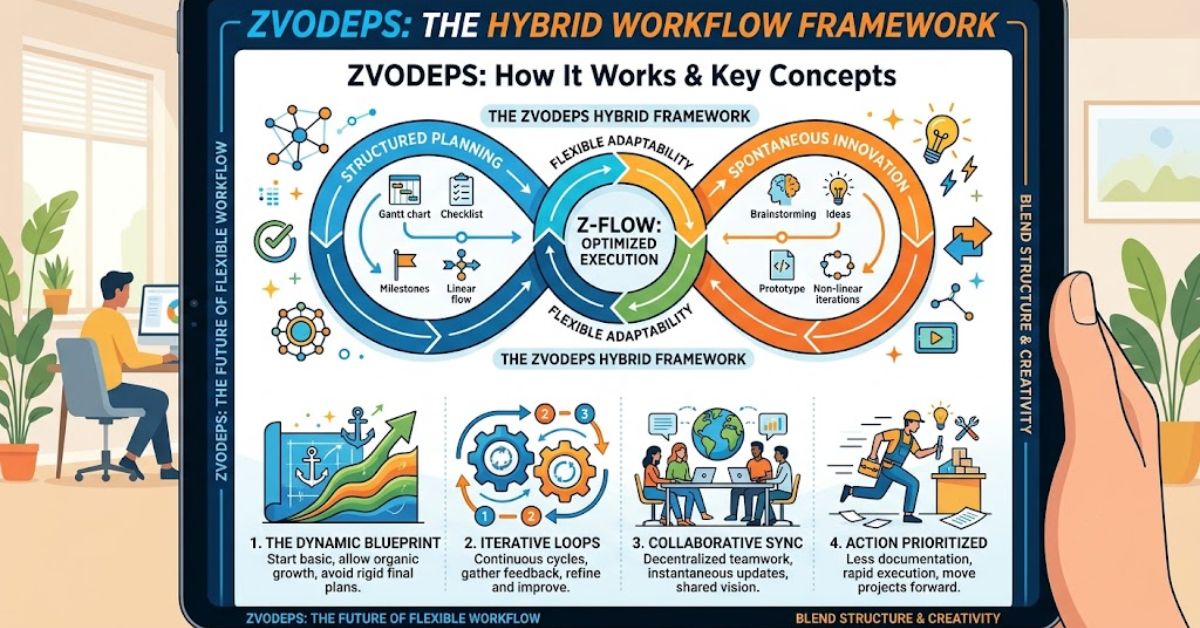
Zvodeps is best understood as a conceptual approach to digital productivity and workflow management. Based on descriptions circulating online, it combines structured planning with spontaneous innovation. Instead of forcing every project into a fixed process, the approach encourages users to create systems that can change as their needs change.
At present, Zvodeps should not be confused with an established commercial application. Available descriptions characterize it as a conceptual term rather than a confirmed software product. In practical terms, this means readers should think of it as a methodology, mindset, or possible framework, not as a specific app they can download and install.
The central idea can be summarized through several principles:
- Flexibility: Workflows should adapt to changing circumstances.
- Creativity: Systems should leave room for experimentation.
- Structure: Clear goals and organization remain important.
- Collaboration: Teams need shared systems that are easy to adjust.
- Digital productivity: Technology can support flexible organization.
This combination makes the concept interesting because it addresses a common problem in modern work: finding the right balance between structure and freedom.
How the Zvodeps Framework Works

The proposed Zvodeps approach brings together two ideas that are often treated separately. The first is creative flexibility, which allows people to explore new ideas without being restricted by a rigid process. The second is structured planning, which gives projects direction, deadlines, responsibilities, and measurable goals.
A flexible workflow does not mean working without rules. Instead, it means creating a basic structure that can be modified when circumstances change. For example, a design team might begin a project with defined milestones but allow its creative process to evolve as new concepts emerge.
A practical workflow inspired by this concept could include:
- Set a clear objective for the project.
- Break the objective into manageable tasks.
- Leave room for experimentation during execution.
- Review progress regularly.
- Change the workflow when the original process no longer works.
This approach can be useful when projects are unpredictable. It gives people a framework without turning that framework into a permanent limitation.
Key Attributes of Zvodeps
One of the most important characteristics associated with Zvodeps is its attempt to balance imagination and organization. Traditional productivity systems often prioritize consistency. Creative work, however, may require exploration, revision, and unexpected changes. A flexible framework tries to accommodate both needs.
Another important attribute is adaptability. A workflow that works for a small startup may not work for a remote design team or an online educator. The concept therefore suggests that productivity systems should be customizable rather than universally fixed.
| Attribute | What It Means | Potential Value |
|---|---|---|
| Creative flexibility | Encourages experimentation | Supports innovation |
| Structured planning | Establishes goals and priorities | Improves organization |
| Workflow adaptability | Allows systems to change | Helps manage uncertainty |
| Digital organization | Uses modern digital methods | Simplifies collaboration |
| Customization | Adjusts to individual needs | Supports different work styles |
These attributes make the framework potentially useful for people who feel that traditional task-management methods are either too rigid or too complicated.
A Zvodeps-style system could also encourage regular reflection. Instead of assuming that a workflow is perfect from day one, users can ask whether their current process is actually helping them. If a system creates unnecessary complexity, it can be simplified. If a team needs more structure, additional planning tools can be introduced.
Zvodeps vs. Traditional Productivity Tools
It is useful to distinguish between Zvodeps as a conceptual framework and established productivity software. Tools such as Notion and Trello are applications that provide specific features for organizing information, tasks, and projects. Zvodeps, by comparison, is described as an approach that could potentially be applied through different digital tools.
| Factor | Zvodeps Concept | Traditional Productivity Tool |
|---|---|---|
| Nature | Framework or mindset | Software application |
| Main focus | Adaptability and balance | Task or information management |
| Flexibility | Conceptually high | Depends on the platform |
| Required software | None specifically | Requires a particular app |
| Use cases | Creative and changing workflows | Projects, tasks, notes, collaboration |
The distinction matters because users searching for Zvodeps may expect to find an official application. Based on the information available in the supplied topic, there is currently no confirmed commercial Zvodeps platform. The term is better treated as a conceptual idea that may describe a way of thinking about digital work.
In that sense, someone could potentially apply the principles using existing tools. A team might use a task manager for deadlines, a document platform for ideas, and a communication tool for collaboration. The Zvodeps-style element would be the flexible system connecting these activities, rather than the individual applications themselves.
Who Could Benefit From the Zvodeps Approach?

The concept may appeal most to people whose work changes frequently. Designers, for example, often need structured project deadlines while maintaining creative freedom. A highly rigid workflow can make experimentation difficult, while a completely unstructured process can cause missed deadlines.
Startups and remote teams may also find the underlying principles relevant. These organizations often operate in environments where priorities can change quickly. A flexible system can help teams maintain direction without forcing every situation into the same process.
Potential audiences include:
- Designers managing creative projects
- Startup teams dealing with rapidly changing priorities
- Remote workers coordinating across locations
- Educators organizing lessons and digital resources
- Freelancers balancing multiple clients
- Project managers overseeing evolving projects
- Content creators combining planning with experimentation
The approach may also benefit individuals who have tried conventional productivity systems but found them too restrictive. Instead of following a fixed methodology exactly as designed, they can build a personal system around their actual working habits.
Benefits and Limitations of the Zvodeps Concept
The main advantage of this approach is its flexibility. People do not all work in the same way, and different projects require different processes. A system that can adapt may be more practical than one that forces every task into a predetermined structure.
Another potential benefit is the balance between creativity and accountability. Creative freedom can encourage innovation, while structured planning can prevent important work from being forgotten. Combining both ideas may help teams create workflows that are organized without becoming unnecessarily restrictive.
However, the concept also has limitations. Because it is not presented as a standardized software product or universally defined methodology, different people may interpret it differently. Without clear guidelines, flexibility can also become disorganization. For that reason, anyone applying the principles should establish clear goals, responsibilities, and review points.
The best approach is to treat the concept as a starting point rather than a rigid formula. Use the ideas that improve your workflow and discard anything that adds unnecessary complexity.
Conclusion
Zvodeps is best understood as an emerging conceptual approach that combines creative flexibility, structured planning, and adaptable digital workflows. Rather than representing a confirmed commercial software application, the term is currently described as a methodology or mindset for organizing modern work.
Its central appeal is the balance between freedom and structure. Designers, startups, remote teams, educators, and independent professionals may find these principles relevant when traditional productivity systems feel too rigid. Ultimately, the value of the concept lies in creating workflows that are organized enough to provide direction while remaining flexible enough to evolve.