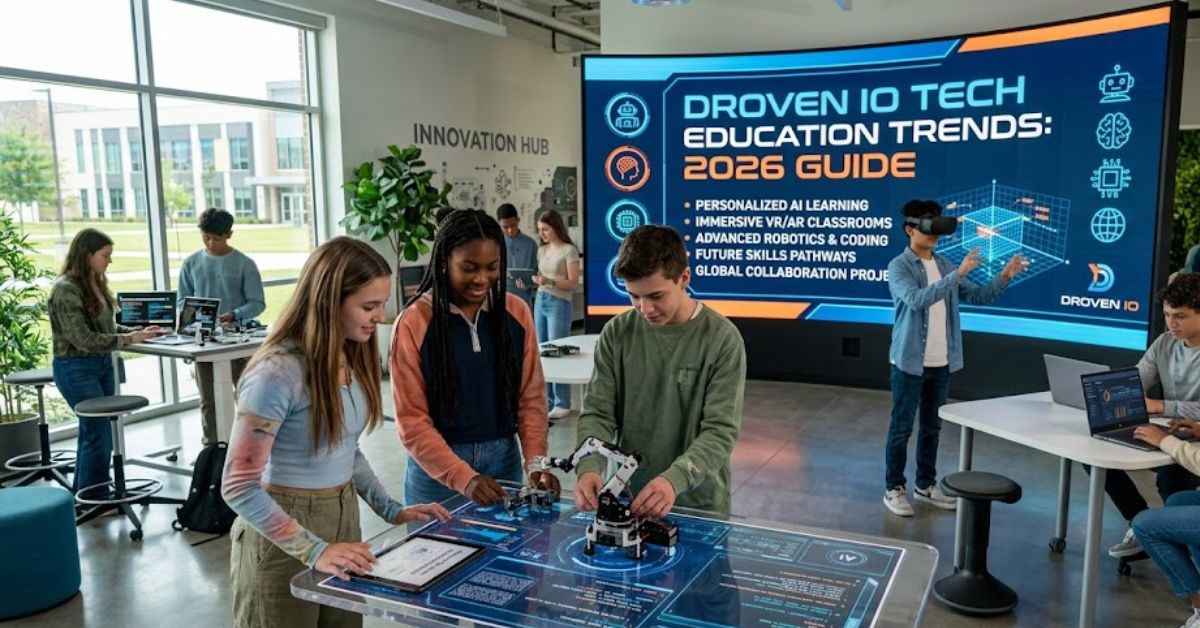
Droven IO Tech Education Trends: 2026 Guide
Technology is changing how people learn, work, and build careers. As digital tools become more powerful, learners need more than access to information. They need practical skills, digital confidence, and the ability to understand complex technology without feeling overwhelmed. This is the broader idea behind Droven io Tech Education Trends, a philosophy centered on making modern technology education simpler, more accessible, and more useful.
Rather than treating technology as something reserved for experts, this approach focuses on breaking difficult subjects into manageable concepts. It emphasizes skills that learners can apply in real situations, including artificial intelligence, cloud technologies, automation, digital safety, and critical thinking. These ideas also connect with major 2026 EdTech trends such as micro-learning, adaptive education, gamification, immersive learning, and micro-credentials.
What Are Droven io Tech Education Trends?
Droven io Tech Education Trends can be understood as an informational approach to technology education that aims to make complex digital topics easier for everyday learners. The emphasis is not on traditional classroom structures or memorizing large amounts of technical information. Instead, the goal is to explain technology in a clear, practical way that helps beginners understand how digital systems work and why those skills matter.
This philosophy is especially relevant as technology becomes part of almost every career. A learner may not become a software engineer, but they may still need to understand AI tools, cloud platforms, automation, cybersecurity basics, or data-driven decision-making. A practical education model helps people develop these capabilities gradually while allowing them to connect learning with real-world applications.
| Traditional Learning Focus | Modern Tech Education Focus |
|---|---|
| Memorization | Practical application |
| Fixed classroom schedules | Flexible learning |
| One-size-fits-all lessons | Personalized learning |
| Long learning sessions | Micro-learning |
| Theory-heavy instruction | Skill-based projects |
| Certificates alone | Demonstrable abilities |
The central idea is accessibility. A beginner should be able to encounter an unfamiliar technology concept and find an explanation that feels understandable rather than intimidating. This makes digital education more inclusive and gives learners a clearer path from basic knowledge to practical competence.
AI-Driven Personalization in Modern Education
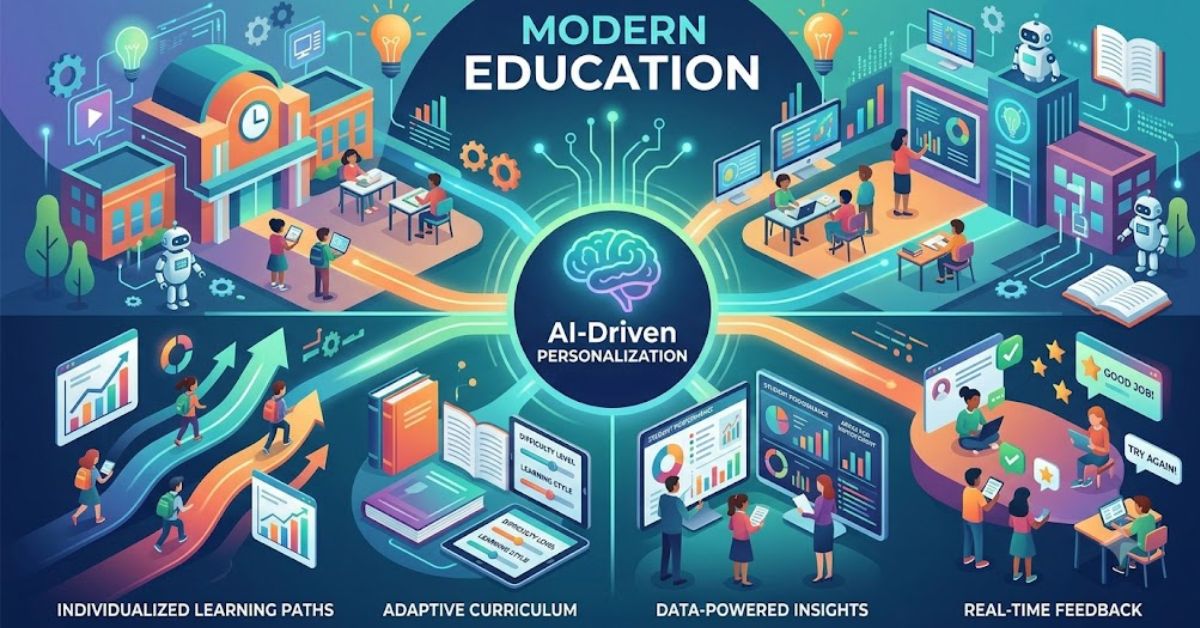
Artificial intelligence is becoming an important part of personalized education. Instead of giving every learner exactly the same experience, AI-powered systems can analyze progress and help adjust the difficulty, pace, or type of learning material. Someone who understands a topic quickly can move forward, while another learner can review fundamentals or receive additional explanations.
This approach can make learning more efficient, but technology should support educators and learners rather than replace human judgment. Effective personalization also requires responsible data practices, transparent systems, and thoughtful human oversight. When used carefully, AI can function as a learning assistant that helps identify knowledge gaps and recommends useful next steps.
Key benefits of AI-supported personalization include:
- Adaptive lesson difficulty
- Progress tracking
- Personalized practice activities
- Faster identification of knowledge gaps
- Additional resources for challenging topics
- Learning recommendations based on performance
For learners exploring Droven io Tech Education Trends, AI personalization represents a shift toward education that responds to individual needs. The broader goal is not simply to use AI because it is popular. It is to use technology where it genuinely improves understanding and gives learners better control over their progress.
Skill-Centric and Practical Technology Education
One of the most important ideas in modern technology education is the move from memorization toward useful skills. Knowing a definition is valuable, but being able to apply that knowledge to solve a problem is often more important. A practical curriculum therefore encourages learners to experiment, build small projects, analyze problems, and understand how technology works in everyday situations.
Core areas may include artificial intelligence fundamentals, basic cloud concepts, automation, programming principles, data awareness, and critical thinking. Learners do not necessarily need to master every technical field. Instead, they should develop enough foundational knowledge to understand digital systems and continue learning as technology changes.
A practical technology learning path might look like this:
- Learn the basic concept.
- Study a simple real-world example.
- Practice the skill with a small task.
- Apply it to a realistic problem.
- Review the results and identify weaknesses.
- Build a small portfolio of completed projects.
This model aligns closely with Droven io Tech Education Trends because it focuses on what learners can actually do. It also supports career readiness by encouraging people to demonstrate abilities through projects and practical experiences rather than relying exclusively on theoretical knowledge.
Flexible Learning and Device-Agnostic Tools
Modern learners often study in different environments. Some use laptops, while others depend primarily on smartphones or tablets. Flexible technology education recognizes this reality by designing learning resources that can work across common consumer devices. This removes some of the barriers associated with fixed schedules, specific locations, or specialized equipment.
Micro-learning is particularly useful in this environment. Instead of requiring learners to complete a long lesson in one sitting, complex topics can be divided into short, focused modules. A learner might spend ten minutes understanding one cloud concept today and return tomorrow to practice it. This approach can make consistent learning easier to maintain.
| Learning Approach | Best Use |
|---|---|
| Micro-learning | Quick concepts and revision |
| Video lessons | Visual explanations |
| Interactive simulations | Complex processes |
| Practical projects | Skill development |
| Mobile learning | Flexible study |
| Digital certificates | Skill validation |
Device flexibility also supports lifelong learning. People can continue developing skills during breaks, commutes, or other convenient periods. The important principle is that technology should adapt to learners’ circumstances instead of forcing every learner into the same environment.
Digital Literacy, Safety, and Ethical Technology Use
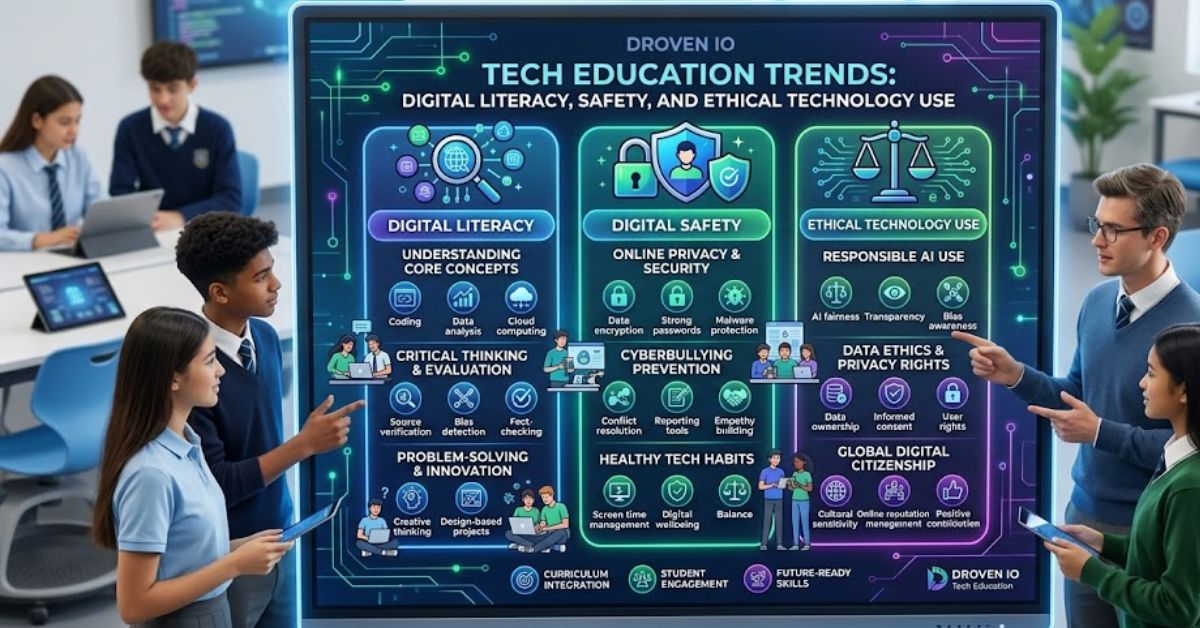
Technology education should not focus only on technical abilities. Digital literacy is equally important because learners interact with online platforms, AI systems, social networks, and cloud services every day. Understanding how to protect personal information and recognize unreliable content is now a fundamental part of being digitally capable.
A responsible learner should understand basic practices such as:
- Creating strong, unique passwords
- Using multi-factor authentication when available
- Protecting sensitive personal information
- Checking information across reliable sources
- Recognizing suspicious links and messages
- Respecting privacy and intellectual property
- Thinking critically about AI-generated content
These principles are an important part of Droven io Tech Education Trends because accessible technology education should also promote responsible technology use. Digital skills become more valuable when learners understand both what technology can do and the risks that come with using it.
Critical thinking is particularly important in an age of AI-generated content. Learners should not automatically accept information simply because it appears professional or is produced by a sophisticated tool. They should ask questions, verify important claims, consider the source, and recognize uncertainty. These habits strengthen digital confidence while reducing the risk of misinformation.
Major 2026 EdTech Trends That Align With the Model
The broader education technology sector is moving toward more personalized, flexible, and interactive experiences. Several trends closely align with the principles associated with Droven io Tech Education Trends. These include micro-learning, immersive technologies, gamification, and skills-based credentials.
Micro-learning breaks large subjects into focused units that are easier to consume and review. AR and VR can make abstract concepts more visual by allowing learners to explore simulated environments. Gamification introduces challenges, progress indicators, and rewards to encourage engagement. Meanwhile, micro-credentials provide learners with smaller, targeted ways to demonstrate specific competencies.
| EdTech Trend | How It Supports Learners | Example |
|---|---|---|
| AI personalization | Adapts learning experiences | Customized practice |
| Micro-learning | Makes study manageable | Short skill modules |
| AR/VR | Makes concepts interactive | Virtual simulations |
| Gamification | Encourages engagement | Challenges and rewards |
| Micro-credentials | Validates specific skills | Digital certificates |
These trends are most effective when they serve a clear educational purpose. Technology should not be added simply because it is new. A useful tool is one that improves comprehension, increases accessibility, supports practice, or helps learners demonstrate meaningful skills.
How Learners Can Benefit From These Trends
Learners can use these ideas to create a more practical and sustainable approach to technology education. Instead of attempting to master everything at once, they can choose one skill, study the fundamentals, and gradually apply what they learn. This approach reduces information overload and creates visible progress over time.
A simple learning checklist can include:
- Choose one technology skill to develop.
- Learn the basic concepts first.
- Use short lessons for regular study.
- Practice through realistic examples.
- Complete a small project.
- Review mistakes and improve.
- Document completed work.
- Consider a relevant micro-credential.
For example, a beginner interested in AI might first learn basic AI terminology. Next, they could explore responsible AI use and experiment with simple tools. Later, they might study data concepts or automation. This gradual progression turns a broad subject into a series of achievable learning goals.
The biggest advantage of this model is flexibility. Learners can combine formal education, online resources, practical projects, and professional certifications. The result is a learning journey that focuses on continuous skill development rather than treating education as something that ends after graduation.
Conclusion
Droven io Tech Education Trends represent a practical philosophy for making modern technology education easier to understand and more relevant to everyday learners. The approach emphasizes AI-supported personalization, real-world skills, flexible learning, digital safety, and critical thinking rather than relying only on memorization or traditional classroom structures.
Its principles also align with important EdTech developments, including micro-learning, AR and VR experiences, gamification, and micro-credentials. As technology continues to influence education and employment, learners who build adaptable digital skills will be better prepared for change. The most effective technology education is ultimately not about using the newest tool. It is about helping people understand technology, apply it responsibly, and continue learning with confidence.