
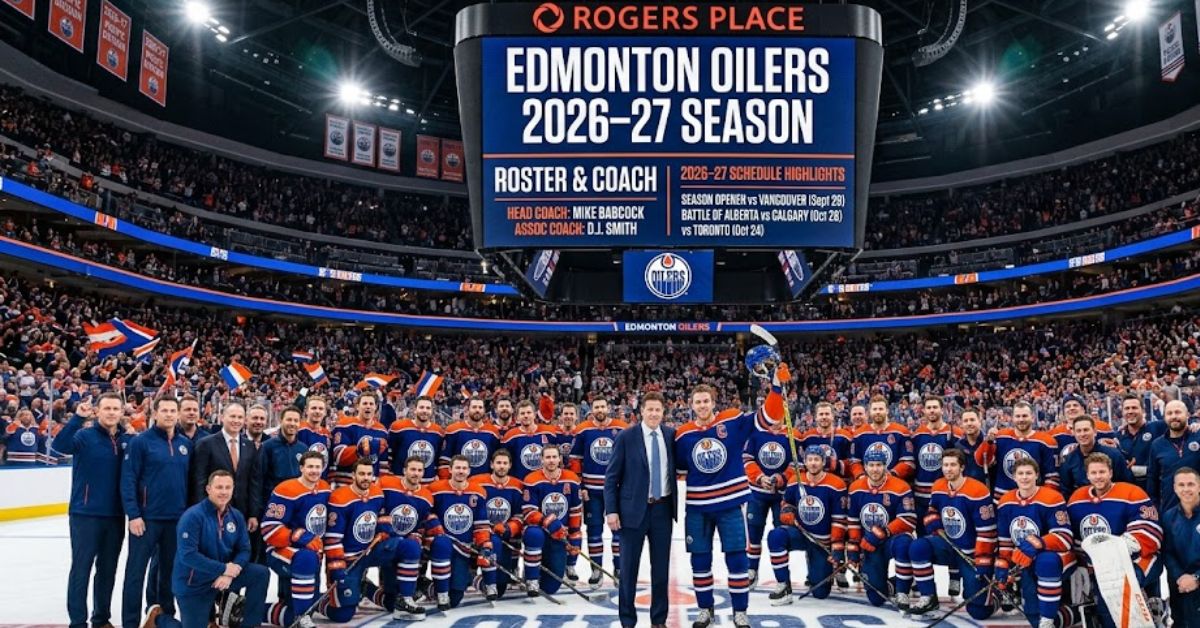
Edmonton Oilers 2026–27 Roster, Coach and Schedule
The Edmonton Oilers enter the 2026–27 NHL season with familiar championship expectations but a very different supporting cast. Edmonton finished 41-30-11 and second in the Pacific Division last season, then lost to the Anaheim Ducks in six games in the first round. That abrupt exit was followed by a major reset rather than another series of minor adjustments around Connor McDavid and Leon Draisaitl.
General manager Stan Bowman changed the coach, moved a longtime defenseman, added two goaltenders, and rebuilt several depth roles. The objective is clear: preserve Edmonton’s elite scoring ceiling while creating a deeper, more reliable team for an expanded 84-game schedule. The roster is not final, and training camp will settle several jobs, but the Oilers already look meaningfully different from the group that ended last spring.
Why the Edmonton Oilers Changed Course After 2025–26
The 2025–26 regular season was respectable, but it fell below the standard Edmonton had created through consecutive Stanley Cup Final appearances in 2024 and 2025. A 93-point finish still secured home-ice advantage in the opening round, yet the Oilers could not contain Anaheim’s offense. The Ducks won the series 4-2 and ended Edmonton’s attempt to reach a third consecutive Stanley Cup Final.
That result exposed a simple problem: star power could not cover every weakness. Edmonton needed more dependable defending, a clearer goaltending plan, and bottom-six players capable of handling difficult minutes. The offseason strategy addressed those areas directly. It did not eliminate risk, but it redistributed salary and roster positions toward depth, competition, and lineup flexibility instead of returning with essentially the same structure.
| Area | 2025–26 concern | 2026–27 response |
|---|---|---|
| Coaching | First-round elimination | Mike Babcock hired |
| Goaltending | No established long-term answer | Frederik Andersen and Devon Levi added |
| Defense | Need for greater flexibility | Ryan Shea and Shakir Mukhamadullin added |
| Salary cap | Expensive existing structure | Darnell Nurse’s full contract moved |
| Forward depth | Need for stronger support minutes | Mathieu Joseph and other depth options added |
The changes summarized above were announced through official Oilers and NHL transaction reporting.
Mike Babcock Takes Over Behind the Bench
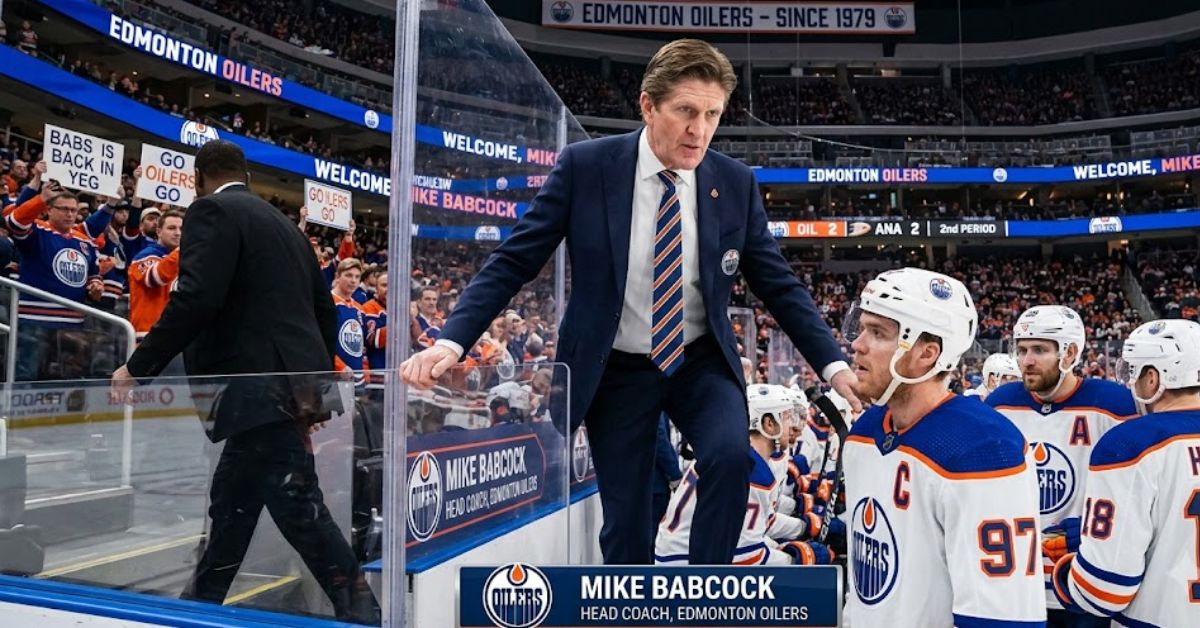
Edmonton hired Mike Babcock as the 19th head coach in franchise history on June 23, 2026. He arrived with a 700-418-183 regular-season record, 90 playoff wins, and a 2008 Stanley Cup championship with Detroit. His résumé brings experience to a team that does not require a rebuild. It needs sharper execution, stronger defensive habits, and better performance when a playoff series becomes chaotic.
The coaching change also raises a practical question: can Babcock add structure without reducing the speed and creativity that make Edmonton dangerous? McDavid and Draisaitl must remain the offensive engine, while the rest of the lineup provides cleaner exits, better coverage, and more consistent special-teams support. The appointment will ultimately be judged by postseason results rather than reputation because this roster has been constructed to contend immediately.
Babcock’s most urgent responsibilities include:
- Establishing dependable defensive pairings
- Defining the starting and backup goaltending roles
- Improving five-on-five defensive consistency
- Giving younger players clearly defined responsibilities
- Preventing excessive dependence on McDavid and Draisaitl
How the Edmonton Oilers Retooled the Roster
The biggest move was trading Darnell Nurse to the San Jose Sharks for Shakir Mukhamadullin and Zack Sharp. San Jose absorbed Nurse’s entire contract, giving Edmonton valuable salary-cap flexibility. Bowman then used the opening to sign goaltender Frederik Andersen, defenseman Ryan Shea, and forwards Mathieu Joseph, Max Jones, Eduards Tralmaks, and Kasperi Kapanen. Edmonton also acquired young goalie Devon Levi from Buffalo.
The transactions changed both the ceiling and the risk profile. Andersen offers significant playoff experience, but his age makes workload management important. Levi brings long-term upside, while Tristan Jarry remains part of the competition. Shea and Mukhamadullin provide different defensive tools, but replacing Nurse’s heavy minutes will require a group effort. Joseph, Kapanen, and Edmonton’s other depth forwards must provide speed, pressure, and useful penalty-killing minutes.
Major additions at a glance
- Frederik Andersen: Veteran goaltender signed to a one-year deal
- Devon Levi: Young goalie acquired from the Buffalo Sabres
- Shakir Mukhamadullin: Young defenseman received in the Nurse trade
- Zack Sharp: Defensive prospect acquired from San Jose
- Ryan Shea: Mobile defenseman signed in free agency
- Mathieu Joseph: Speed-oriented depth forward
- Kasperi Kapanen: Re-signed after leading Edmonton with four playoff goals
Andersen signed for one year, Levi arrived with a 2028 seventh-round pick, and Shea received a five-year contract. Kapanen, Joseph, Jones, and Tralmaks were also signed or re-signed during Edmonton’s opening free-agency activity.
Projected 2026–27 Lineup and Position Battles
The top of the lineup remains built around McDavid, Draisaitl, Ryan Nugent-Hopkins, Zach Hyman, Evan Bouchard, and Mattias Ekholm. NHL.com’s early projection places Nugent-Hopkins and Hyman with McDavid, while Vasily Podkolzin and Matthew Savoie flank Draisaitl. That configuration can change, but it shows Edmonton’s intention to combine established stars with younger skill instead of placing every proven scorer on one unit.
The most important battles sit lower in the lineup and in goal. Isaac Howard, Josh Samanski, Colton Dach, Max Jones, and other depth options will compete for roles. On defense, Shea and Mukhamadullin must earn trust beside veterans such as Jake Walman and Connor Murphy. Andersen may have the inside track in net, but Jarry and Levi give Babcock alternatives if performance, injuries, or scheduling demand another plan.
| Position group | Early projected core |
|---|---|
| First line | Ryan Nugent-Hopkins – Connor McDavid – Zach Hyman |
| Second line | Vasily Podkolzin – Leon Draisaitl – Matthew Savoie |
| Third line | Isaac Howard – Jason Dickinson – Kasperi Kapanen |
| Fourth line | Mathieu Joseph – Josh Samanski – Trent Frederic |
| Top defense pair | Mattias Ekholm – Evan Bouchard |
| Second defense pair | Jake Walman – Connor Murphy |
| Third defense pair | Ryan Shea – Shakir Mukhamadullin |
| Goaltenders | Frederik Andersen, Tristan Jarry and Devon Levi |
The forward combinations and defensive pairs reflect NHL.com’s early offseason projection, while Levi remains part of Edmonton’s wider three-goaltender competition. The opening-night lineup may change substantially during camp.
Edmonton Oilers 2026–27 Schedule and Key Dates
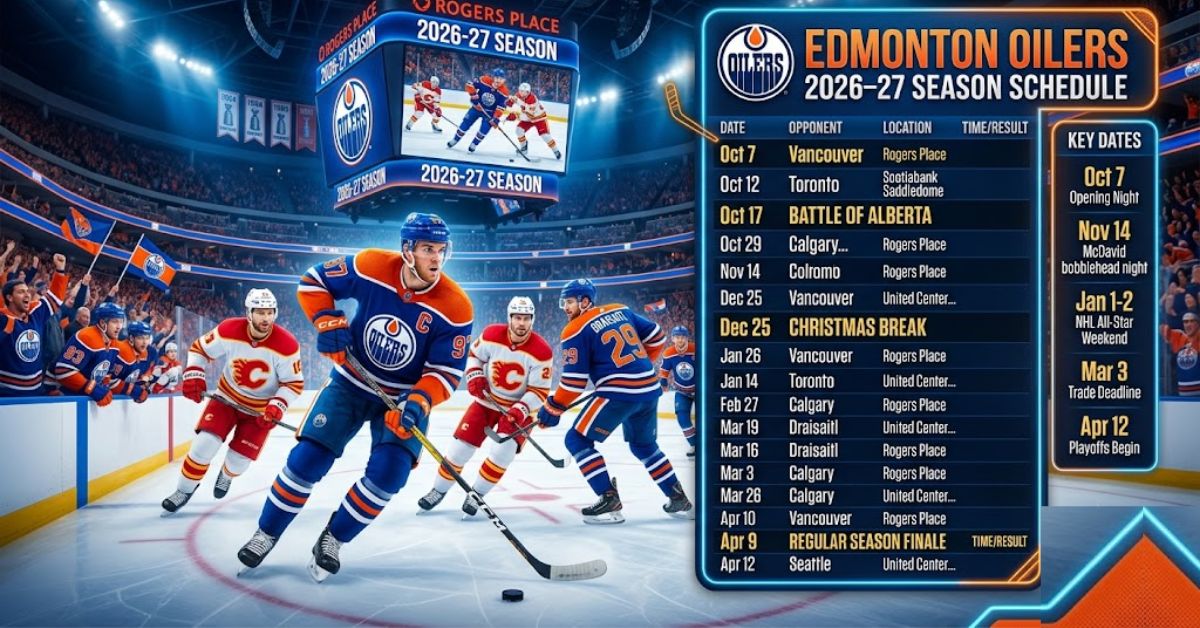
The 2026–27 NHL season expands to 84 games, increasing the value of depth and workload control. Edmonton opens the regular season at Rogers Place against Vancouver on September 29, then completes the home-and-home series in Vancouver on October 1. The official preseason begins September 19 against Winnipeg—not September 20—and ends September 26 with a home game against Calgary.
October quickly tests the reconstructed roster. Edmonton hosts the defending Stanley Cup champion Carolina Hurricanes on October 22, welcomes the Toronto Maple Leafs on October 24, and plays its first Battle of Alberta against Calgary on October 28. Those games will not decide the season, but they should reveal how quickly the Oilers absorb Babcock’s system and whether their new defensive and goaltending combinations can handle strong opponents.
| Date | Game | Why it matters |
|---|---|---|
| September 19, 2026 | Preseason vs. Winnipeg | First game under the new coaching staff |
| September 29, 2026 | Home vs. Vancouver | Regular-season opener |
| October 1, 2026 | At Vancouver | Completes the opening home-and-home |
| October 22, 2026 | Home vs. Carolina | Test against the defending champion |
| October 24, 2026 | Home vs. Toronto | High-profile Canadian matchup |
| October 28, 2026 | Home vs. Calgary | First Battle of Alberta |
What Must Go Right for a Stanley Cup Run
For Edmonton to become a serious Stanley Cup threat, three areas matter most. First, the team needs stable goaltending rather than another rotating crisis. Second, the reconstructed defense must limit dangerous chances without sacrificing puck movement. Third, the bottom six must win enough shifts to prevent McDavid and Draisaitl from carrying every difficult matchup. None of those goals requires perfection, but all three must improve together.
The realistic outlook is cautiously positive. Edmonton still owns two of hockey’s best players and retains high-end talent throughout the lineup. However, the offseason did not guarantee improvement; it created better options. Babcock must organize those options, the goaltenders must separate themselves, and younger players must convert potential into dependable minutes. The Oilers should remain a Pacific Division contender, but their postseason ceiling will depend on balance rather than name recognition.
Edmonton’s championship checklist
- Establish a reliable starting goaltender.
- Replace Nurse’s minutes across multiple defensive pairs.
- Improve defensive-zone coverage at five-on-five.
- Build a bottom six that can handle difficult matchups.
- Integrate Savoie, Howard, Levi, and other younger players.
- Manage Andersen, Ekholm, and other veterans through 84 games.
- Enter the playoffs with settled lines and defensive pairings.
Conclusion
The Edmonton Oilers responded to a disappointing first-round exit with one of the NHL’s most aggressive roster resets. Mike Babcock takes over behind the bench, Nurse is gone, and Andersen, Levi, Shea, Mukhamadullin, Joseph, and other additions reshape the supporting cast. The core objective has not changed: maximize the championship window around McDavid and Draisaitl while becoming harder to expose during a seven-game series.
The 2026–27 season will show whether those changes created a complete contender or simply a different version of the same top-heavy team. Edmonton has more competition, additional defensive options, and a deeper goaltending pool, but the final verdict belongs to the playoffs. For fans tracking the Edmonton Oilers, the question is no longer whether the roster has talent. It is whether the new structure can turn that talent into four successful rounds.