
Zuhio Keyword Count Checker: How to Use It
The Zuhio Keyword Count Checker gives writers a fast way to review how often words and phrases appear in a draft. Instead of guessing whether a target term is missing, repeated too often, or poorly placed, users can examine frequency, density, total word count, and phrase patterns. The tool is especially useful during editing because it turns a vague SEO concern into measurable information that can guide clearer, more natural revisions.
Keyword data should support writing, not control it. A page does not rank simply because it reaches a chosen percentage. Google recommends helpful, reliable, people-first content and warns against repeating phrases so often that the writing sounds unnatural. A keyword checker is therefore best treated as a diagnostic tool. It can reveal patterns and possible problems, but the final decision must still depend on relevance, readability, search intent, and genuine usefulness.
What Is the Zuhio Keyword Count Checker?
The Zuhio Keyword Count Checker is a free, browser-based SEO content analysis tool that examines keyword usage in pasted text or a live web page. Its main purpose is simple: show how many times a word or phrase appears and estimate its share of the full document. Zuhio presents itself as a focused micro-tool rather than a large SEO platform, making it suitable for quick checks without a complicated setup. word frequency checker works as a lightweight keyword density checker and SEO content analyzer for bloggers, copywriters, editors, agencies, and business owners. It can confirm whether a primary search term appears enough to establish topical focus. It can also expose unnecessary repetition, weak phrase variation, or missing placement in important elements. However, it does not replace keyword research, fact-checking, competitor analysis, technical SEO, or a professional editorial review.
| Metric | What It Shows | Why It Matters |
| Word count | Document length | Adds context |
| Keyword frequency | Exact number of uses | Reveals repetition |
| Keyword density | Percentage of total words | Flags concentration |
| Phrase groups | Two- to four-word combinations | Finds long-tail patterns |
| HTML placement | Use in titles and headings | Checks key locations |
How the Tool Analyzes Keywords and URLs
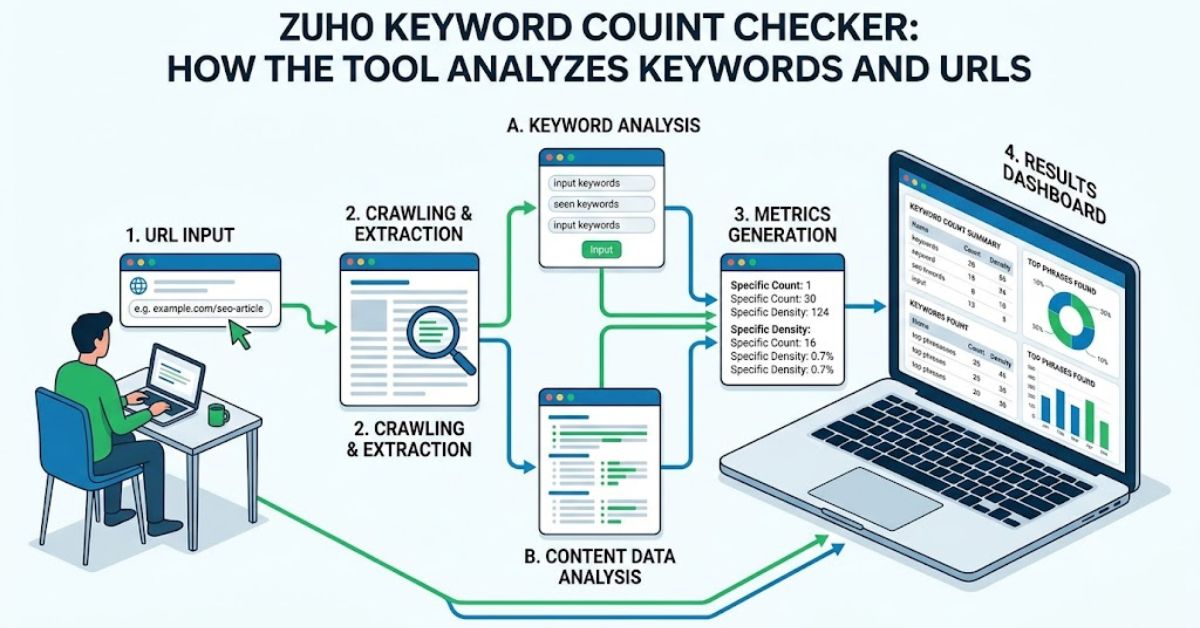
The tool can process raw copy pasted into its dashboard or scan a live URL when the page is publicly accessible. Text input is best for drafts that have not been published. The URL keyword analyzer option is better for checking existing articles, landing pages, or competitor content. A scan may be incomplete when a page blocks automated access, requires a login, loads important text through scripts, or contains material the checker cannot retrieve.
Its phrase detection is more useful than a basic word counter because search queries often contain several words. The phrase frequency report groups text into two-word, three-word, and four-word combinations, revealing repeated topic phrases, long-tail keywords, product terms, and awkward patterns. It may also review placement in titles, meta descriptions, and heading tags. That breakdown helps users distinguish healthy topical coverage from repetition concentrated in one section or HTML element.
How to Use the Zuhio Keyword Count Checker
Using the Zuhio Keyword Count Checker should be a final editing step, not the first stage of writing. Create a complete draft that answers the reader’s question, then analyze it. This order prevents you from forcing the same phrase into every paragraph. Before starting, identify one primary keyword, several closely related terms, and the main search intent. That preparation makes the report easier to interpret and reduces pointless changes based only on raw numbers.
After the report appears, begin with the total word count and the exact frequency of your primary phrase. Next, review related phrases and their locations. Look for sections where repetition affects clarity, as well as sections where important concepts are absent. Do not automatically remove every repeated phrase or add a keyword to hit a target. Edit only when the change improves meaning, strengthens topic coverage, or makes the page easier for a real reader to understand.
- Paste completed text or enter a public URL.
- Run the analysis and confirm the word count.
- Review exact frequency and density.
- Check phrases and important HTML locations.
- Revise only when the content improves.
How to Interpret Keyword Frequency and Density
Keyword frequency is the number of times a specific term appears. Keyword density expresses that frequency as a percentage of the document’s total word count. A simplified formula is: keyword occurrences divided by total words, multiplied by 100. For example, eight uses in a 1,000-word article produce a keyword density percentage of roughly 0.8 percent. Multi-word calculations may vary because different tools can count phrases and tokens differently.
| There is no universal keyword density that guarantees rankings or prevents a penalty. A range such as 0.5 percent to 2.5 percent may help editors notice unusual repetition, but it is not a Google rule. Google’s spam policy focuses on words or phrases repeated so frequently that they sound unnatural or appear designed to manipulate rankings. Context matters more than a single percentage, especially for branded names, technical terms, and short product pages. Pattern | Likely Meaning | Recommended Action |
| Main term appears rarely | Topic focus may be unclear | Add it where relevant |
| Exact phrase repeats heavily | Copy may sound forced | Rewrite repeated passages |
| Related phrases are missing | Coverage may be narrow | Add useful concepts |
| Keywords cluster in one section | Distribution may feel unnatural | Improve structure |
Zuhio Compared With Other SEO Review Methods

The strongest benefit of Zuhio is speed. A basic word count tool or document search can find exact matches, but manual review becomes tedious with several phrases. Full SEO suites provide deeper competitor, search volume, and optimization data, yet may require subscriptions or more setup. A focused checker sits between those options. It offers enough information for an editorial review without turning a simple keyword count into a large research project.
Choose the method according to the decision you need to make. Use a spreadsheet or document search for a quick exact-match count. Use a broader SEO suite when you need search volume, ranking difficulty, SERP analysis, content briefs, backlinks, or site-wide auditing. No single method covers every part of search optimization, so combining tools is often more practical.
| Method | Best For | Main Limitation |
| Zuhio checker | Fast phrase and density review | Limited broader research |
| Manual search | One phrase in short copy | Slow for many terms |
| Full SEO suite | Competitor and SERP research | More cost and complexity |
Best Practices, Limitations, and Publishing Checks
A useful keyword report should lead to better writing, not mechanical editing. Keep the primary term in prominent locations when it fits naturally, including the page title, main heading, opening context, and relevant subheadings. Google recommends using the words people search for in prominent page locations, while also requiring people-first content. The goal is clear subject identification. It is not maximum repetition, exact-match saturation, or inserting keywords into sentences where they do not belong. ublishing, read the page aloud and review every highlighted phrase in context. Replace repeated wording only when the meaning stays accurate. Add missing entities, examples, definitions, or supporting details when the content feels thin. Complete the on-page SEO analysis by checking whether the title and meta description describe the page honestly. Finally, confirm that image alt text explains the image instead of becoming another keyword list designed only for search engines. ng checklist:
- The main topic is clear in the opening.
- Keywords fit the sentence and search intent.
- Headings describe their sections accurately.
- Repetition does not distract from meaning.
- The title, description, and alt text stay descriptive.
Conclusion
The Zuhio Keyword Count Checker makes keyword analysis easier by combining frequency counts, density estimates, phrase detection, word totals, and placement review in one focused workflow. It can help users find underused topics, repetitive wording, and missed on-page opportunities before publication. Its value comes from making content patterns visible. The numbers are useful signals, but they should never override accuracy, readability, brand voice, or the needs of the audience.
For the best result, write for the reader first and use the checker during revision. Review the primary keyword, related phrases, important tags, and overall balance, then make only changes that improve the page. Avoid treating density as a ranking formula. Used with sound keyword research, thoughtful editing, and people-first SEO principles, the Zuhio Keyword Count Checker can become a practical quality-control step for blog posts, service pages, landing pages, and other search-focused content.